logo

Jolly Phonics Teacher's Guide

Secure It Sessions

TIER 2: Focused interventions

For pupils who need extra practice

Some pupils don’t have a specific learning difficulty or language barrier – but they still fall behind if they don’t get enough repetition, or exposure. These children benefit greatly from targeted, regular support that helps them stay on track with the rest of the class. This page offers practical strategies to help those pupils “Secure It” before they seriously fall behind.

Often the problem is a poor memory and these children need regular, small group intervention to allow them to keep up with the rest of the class. Three to five children per group works well.

Short daily revision sessions before or after lunch or before going home, which involve the whole class are valuable.

Teachers usually know who is struggling but they need to find out and target the gaps in the pupil’s knowledge and skills. They can do this using the assessment tool or the assessment check lists from the free resources section of the website.

Small Group Sessions

Ideally these small group sessions should be in a quiet area away from the main class.

Working individually or in a small group works well. Keeping the same helper and the same group of pupils is best. These short sessions should contain revision of the letter sounds, word blending practice, segmenting and dictation of letter sounds and words. Choose pupils who are have similar problems or are at the same level to be in the group.

These sessions can be at various times during the day depending on when help is available. Daily sessions are ideal but three sessions a week works well, too. They should be quick snappy sessions of about 15-20 minutes. The aim is to ‘catch up and keep up’. Try to use only one activity for every skill being revised.

Those skills that need practice should be concentrated on during these sessions. It is up to the teacher or adult to decide which activities are needed.

Activity Ideas

Each session should contain activities to practice:

1
Learning the Letter Sounds
  • Letter Sound Box - Each pupil should have their own Letter Sound Box. The box contains letter cards for the pupil to go through. It can be used in school as well as being sent home. It should contain the letter sounds that are known by the child. Going through these helps develop automaticity, fluency and puts it into long-term memory. Letter sounds can be added to this box at a rate that is suitable for the pupil. The pupil needs to feel confident and not that they are continually getting things wrong. Gradually build up the letter sounds in their boxes, as quickly as possible, allows the pupils to feel successful.
  • Letter Sound Race - The letter sounds are held up, one at a time. The first pupil to say the sound gets the card. At the end the pupils see who has the most cards. Ensure the pupils are of similar ability.
  • Letter Sound Places - Deal out 5 letter sound cards to each pupil. They put them on the table in front of them, with the letters face up. Go round the group and each pupil points to and says the sounds they have as quickly as they can. They can then move to a different place and the activity is repeated with a different set of letters. After they have said the sounds they can us the letters sounds in front of them for word building. (See segmenting section)
  • Turn and Say the Sound - Lay the letter cards face down in the middle of the table. The pupils take it in turns to turn over a card. If they say the correct letter sound they keep the card. If not they have to turn it back facedown and leave it on the table. When all the cards are gone they count up and see who has the most cards.
2
Word Blending

Words that have been blended a few times become known, and then blending is not needed for those words. In the early stages most words are not known. Take care to only use words that have letter sounds that are known to the pupils.

  • Auditory blending - Auditory blending is only needed if a pupil cannot hear the word when they say the letter sounds. In this activity the adult says the letter sounds for a word and asks the pupil(s) to blend it and encourage them to say the word. A few quick examples in each session gradually develops this essential skill.
  • Auditory blending with pictures - Put out two pictures, sound out the word for one of them, and ask the pupil to blend the word and point to the correct picture. This activity is the easiest way to help a struggling child. When appropriate increase the number of pictures.
  • Blending for reading - Deal out 3 - 5 word cards to each pupil. The pupils have to blend and say the words as quickly as possible. The other pupils watch and check the word is read correctly and can offer help if necessary. Alternatively, the adult could call out one of the words and the pupil indicates if they have that word. It could then be turned over. The activity is finished when all the words are faced down.
  • Silent blending - Deal out 3-5 word cards to each pupil and, if appropriate, ask them to say the words straightaway. If they do not know a word encourage them to blend silently in their head and say the word.
  • Who can read it first? - Show a word card to the group. Whoever gives the answer first keeps the card. Continue with some more words. At the end each pupil counts their cards and the winner is declared.
3
Segmenting - Identifying Sounds in Words

Some children initially are unable to hear the sounds in words. Fortunately they can be successfully taught this essential skill, which enables them to understand how the English alphabetic code works for writing words.

  • Holding up a finger for each sound - Say a short regular word and ask the pupils to say the sounds in the word, holding up a finger for each sound. Repeat with a few words. If they are finding this difficult then model it for them, using ‘I do it, we do it, you do it’.
  • Word building - Put some plastic letters or letter cards on the table in front of each pupil. Then say a word and ask the pupils to make the word from the letters. Whoever has the letter for the first sound puts it into the middle of the table. This continues until the word has been built. The pupils then blend it to check if it is correct.

Secure-It Session Essential

Phonics Cards Blue

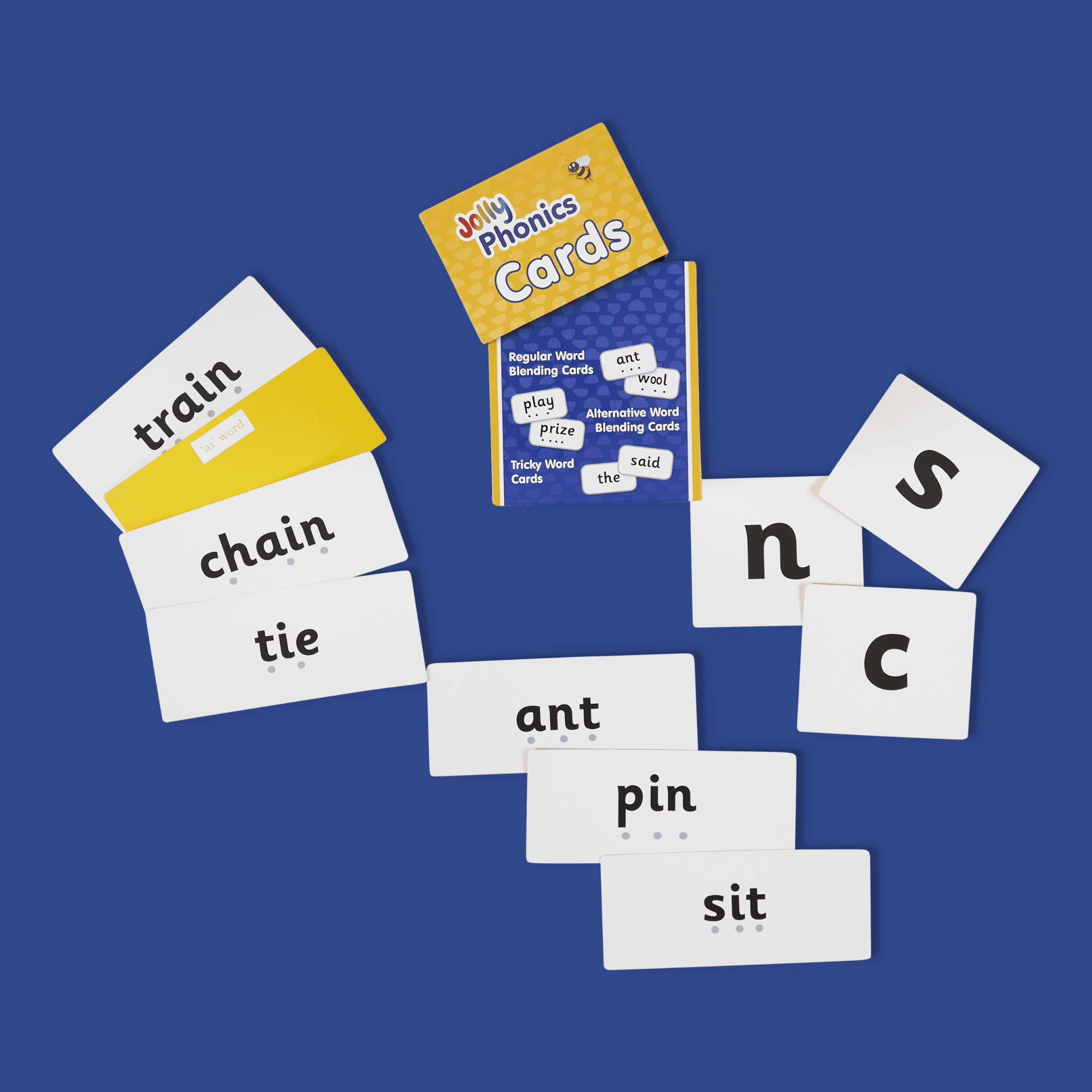
Jolly Phonics Cards

Four flashcard sets for daily teaching, revision and games. Covering letter sounds, regular and alternative word blending (with sound dots for support) and tricky words in teaching order. A practical resource for reinforcing phonics skills at every stage.

SHOP NOW
4
Dictation - Letter Sounds and/or Words
  • Letter Sound Dictation - This activity is important and is often overlooked. Being able to write the correct letter/s when hearing a sound is the first step towards writing words. Until the pupils have automaticity in this it should be done in most sessions. Call out a few letter sounds for the pupils to write the associated letters, on paper, on lines or on boards. Check their pencil hold and formation while they write. It also re-enforces their knowledge of the letter-sound correspondences.
  • Word Dictation - Call out a few words for the pupils to write on paper, on lines or on boards. Check their pencil hold and formation while they write. Using joined letters for digraphs re-enforces their knowledge of these letter-sound correspondences and means they are less likely to only write one of the letters needed. It also prepares them for joined up writing later on. When the pupils know how to spell the first group of tricky words, then a sentence that uses one of those tricky words and regular words made from known letter sounds can be dictated.
5
Tricky Words

Tricky words are frequently used words that have an unusual letter-sound correspondence that has not been taught yet or are irregular e.g. ‘was’ has an /a/ sound that is pronounced as /o/. This is the ‘tricky’ bit of the word. Identifying it helps the pupils to memorise it.

  • Quick flashcard revision - As fast as possible hold up tricky-word flashcards that you have been working on. Give the card to whoever is first to say the sound. If there is a tie put the card back in the pile. Each pupil counts the card they have won and the winner is declared.

  • Say it as it sounds - Saying a tricky word as it sounds is a great way of helping pupils remember the tricky bit and how to spell it. For example, you say the word was /woz/ and the pupils call out /was/.

  • Tricky word dictation - A quick dictation of a few words, that you have been working on with the pupils, provides practice for the pupils and gives the adult helper a check on what is known by each pupil.

  • Tricky words at home - As soon as a pupil is fairly confident with a tricky word it could be added to their Letter Sound Box for practice at home. This extra support develops fluency and puts the words into long-term memory.

PREVIEW LESSON
Looking for practical ideas to support pupils?

Helping pupils who need more time to secure key skills.

Great Secure It Resources

Picture Flashcards   Blue

Jolly Phonics Picture Flashcards

Sixty cards showing pictures with sound dots on one side and matching letters and words on the reverse. Great for introducing sounds, playing recognition games and extending vocabulary in a fun interactive way.

New Magnetic Letters

Jolly Phonics Magnetic Letters

A hands-on resource with lower-case letters in red (consonants) and blue (vowels). Children build and break apart words, strengthening blending and segmenting skills while linking phonics knowledge directly to spelling and reading activities.

Tricky Words

Jolly Phonics Tricky Word Wall Flowers

Colourful displays of 72 tricky words in six flower sets. Each word is added around the central hat as taught, giving children clear visual cues that make locating and recalling tricky words engaging and effective.

Focused support to help every learner succeed.SHOP ALL