





Research

Over the past 30 years, Jolly Phonics has continued to be used successfully in classrooms around the world.


Below, we are delighted to showcase some of the external research that has been conducted that highlights the impact our systematic synthetic approach continues to have. 

Thank you to each researcher who has shared their findings with us and allowed us to host their papers here. 

Teacher working with children on reading and writing

Explore the research

Showing 22 of 22 studies

Research studies

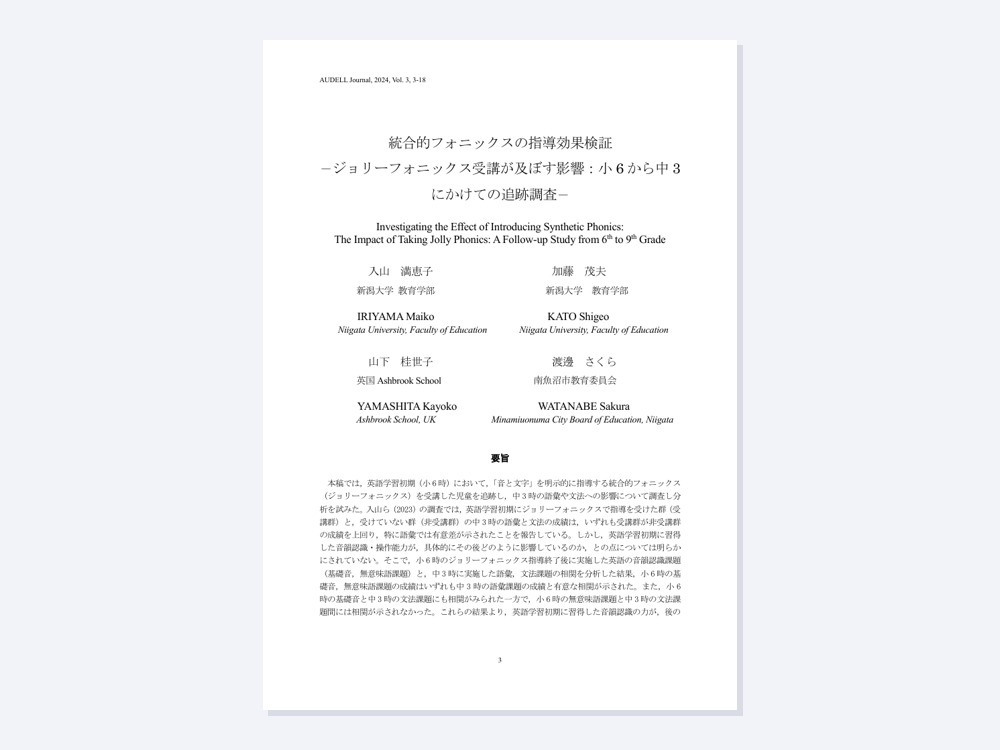
First page of the 2024 Japanese research paper by Iriyama and colleagues

Follow-up study · Japanese · 2024

Minamiuonuma, Niigata, Japan

From Grade 6 to Grade 9: a Jolly Phonics follow-up

Maiko Iriyama, Shigeo Kato, Kayoko Yamashita and Sakura Watanabe followed pupils who received Jolly Phonics in Grade 6. Early sound and nonword task scores were associated with Grade 9 vocabulary; basic sound scores were also associated with grammar. These correlations do not establish cause and effect. The Japanese paper appears in AUDELL Journal, Volume 3, pp. 3–18; the link opens the full journal at the paper.

Read journal (PDF 3.2MB)
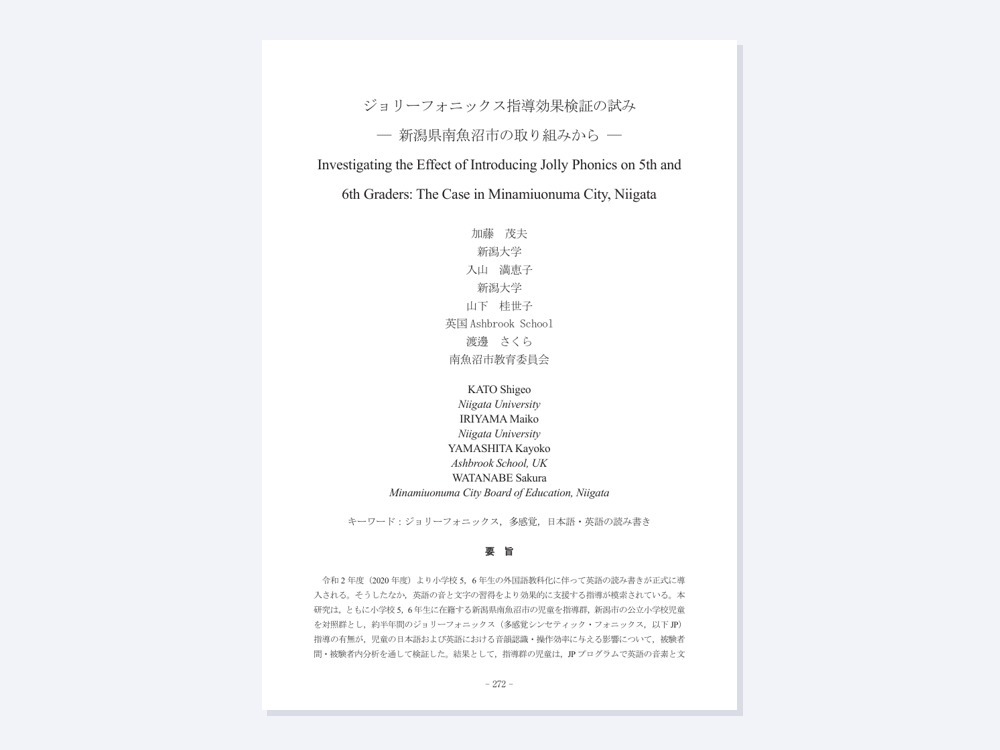
First page of the 2020 Japanese research paper by Kato and colleagues

Comparative study · Japanese · 2020

Minamiuonuma, Niigata, Japan

Jolly Phonics with Grades 5 and 6 in Minamiuonuma

Shigeo Kato, Maiko Iriyama, Kayoko Yamashita and Sakura Watanabe examined approximately six months of Jolly Phonics teaching with Grades 5 and 6 in Minamiuonuma, compared with pupils in Niigata City. The study reports stronger improvements in English phonological awareness and sound manipulation, with possible benefits for Japanese sound manipulation. This was a non-randomised comparison. Published in JES Journal, Volume 20, pp. 272–287.

Read paper (PDF 1.7MB)
Document preview: iPads as part of reading intervention

Doctoral dissertation · 2016

Joliet, Illinois, USA

iPads as part of reading intervention

Lori Motsch compared two annual cohorts of 29 kindergarten pupils receiving reading support, one combining direct teaching with iPad activities. Differences were significant for letter naming and letter-sound fluency, but not phoneme segmentation. The design compares different years and evaluates the intervention package, rather than isolating an app’s effect.

Read source (PDF 683KB)
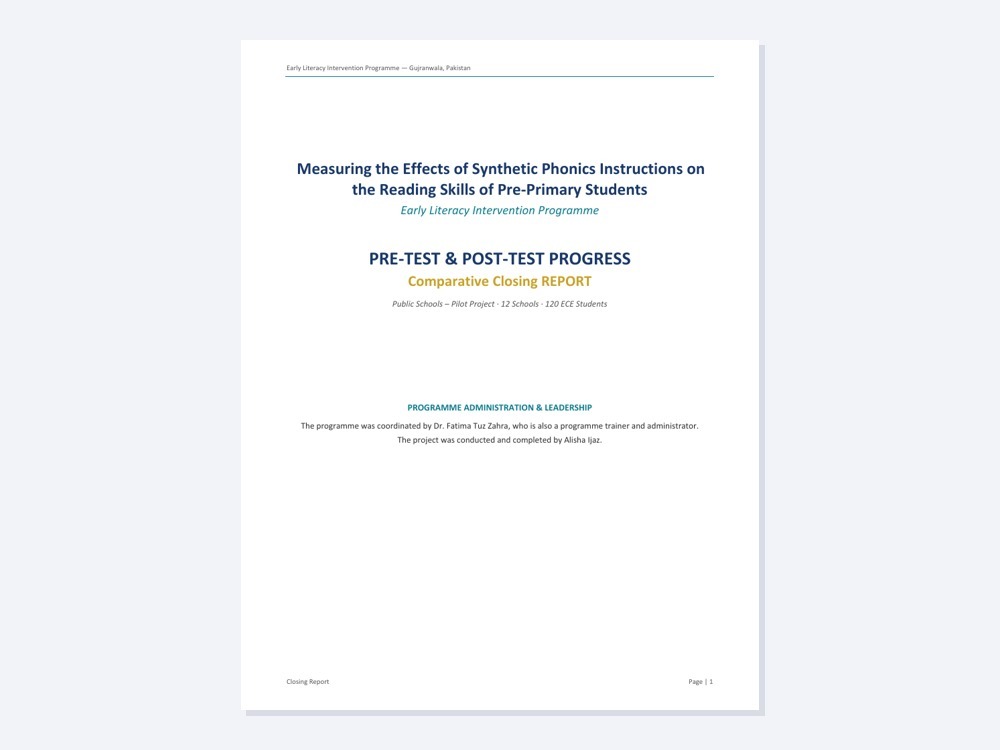
Document preview: Four pilot projects in early English teaching

Pilot report collection · 2016

Pakistan

Four pilot projects in early English teaching

The collection covers AFAQ, Punjab Education Foundation, ITA Lahore and ITA Karachi projects. It compares Jolly Phonics teaching with existing English teaching and reports reading-test outcomes, alongside teacher training and implementation. The overview and four reports belong to one collection and should not be counted as five independent studies.

Read source (PDF 1.5MB)
Document preview: Multisensory phonics and reading motivation

Research report and thesis · Thesis 2015

Iran

Multisensory phonics and reading motivation

Leila Farokhbakht studied early English reading motivation among 100 learners aged 10–12. After one month, pupils taught through multisensory phonics reported higher motivation than the comparison group. Motivation is the focus of this report; the accompanying thesis also addresses literacy learning.

Read source (PDF 635KB)
Document preview: Reading skills, teaching and engagement

Doctoral thesis · 2014

Nigeria

Reading skills, teaching and engagement

Olubusola Eshiet’s study involved 226 pupils, nine teachers and nine schools, with intervention and comparison groups. It reports stronger reading improvement in the synthetic phonics groups and explores pupils’ engagement and teachers’ confidence through observations and interviews. A short executive summary is available alongside the full thesis.

Read source (PDF 185KB)
Document preview: Teaching English through synthetic phonics

University thesis · Italian · 2012–13

Milan, Italy

Teaching English through synthetic phonics

Daniela Caserta’s thesis examines systematic synthetic phonics and the use of Jolly Phonics in Milan. It discusses English teaching in an international school and an Italian state school, alongside teacher preparation and early introduction of English. The full thesis is in Italian.

Read source (PDF 3.4MB)
Document preview: A French-language perspective on English schools

Education commentary · 2012

England · French-language report

A French-language perspective on English schools

Constance de Ayala’s report describes literacy teaching in disadvantaged English state schools and discusses teaching routines, leadership and training. It is a contextual education report published in French, rather than an intervention trial conducted in France.

Read source (PDF 919KB)
Document preview: Multisensory activities and English sounds

Research paper · Japanese · 2010

Japan

Multisensory activities and English sounds

Masamichi Yuzawa and colleagues examine a multisensory approach to English phonological learning among Japanese young children. The paper compares activities and age groups, with tasks assessing English sound awareness and repetition. Read the original Japanese paper for the methods and outcomes; it is not a whole-programme reading evaluation.

Read source (PDF 1.3MB)
Document preview: Early literacy in Indonesian and English

Comparative study · 2008

Indonesia

Early literacy in Indonesian and English

Lisnawati Ruhaena compared two groups of 30 preschool children learning through Jolly Phonics or regular teaching. The study reports stronger initial literacy outcomes for the Jolly Phonics group on its assessment. The paper is in Indonesian with an English abstract, and considers literacy in both languages.

Read source (PDF 54KB)
Document preview: Phonology and reading alongside oral language

Randomised intervention study · Published 2008

Yorkshire, England

Phonology and reading alongside oral language

Bowyer-Crane and colleagues compared two 20-week interventions for 152 children with poor oral language at school entry. Phonology with reading produced stronger literacy and phonological outcomes; oral-language teaching produced stronger vocabulary and grammatical outcomes. The findings highlight the different skills supported by each intervention.

Read source (PDF 822KB)
Document preview: Primary 1 reading development

Preliminary conference paper · 2007

Akwa Ibom, Nigeria

Primary 1 reading development

Comfort Ekpo and colleagues at the University of Uyo studied 168 Primary 1 pupils in five purposively selected schools. The paper reports better reading outcomes for the Jolly Phonics groups and recommends replication. This preliminary study uses intact classes and should be read in the context of its selected schools.

Read source (PDF 196KB)
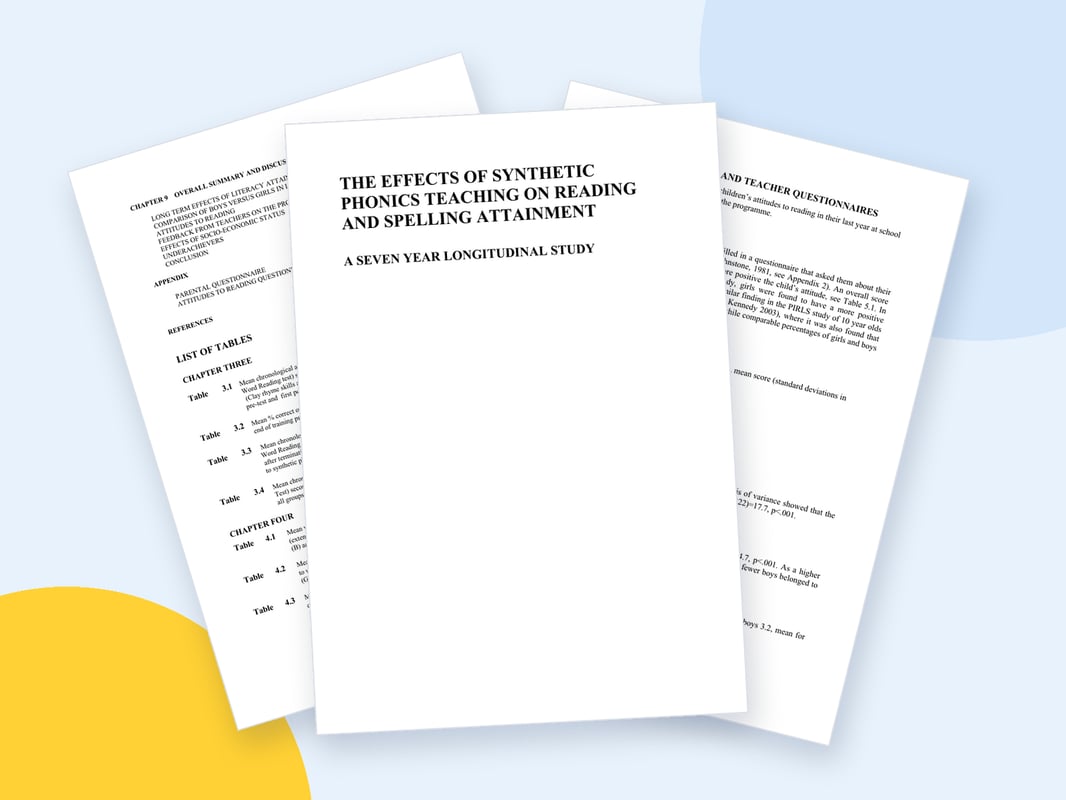
Document preview: Following literacy progress over seven years

Longitudinal report · 2005

Clackmannanshire, Scotland

Following literacy progress over seven years

Johnston and Watson followed children through primary school, measuring word reading, spelling and comprehension. The report records gains on all three measures, of different sizes. All original groups received synthetic phonics by the end of Primary 1, so the later results are a follow-up rather than a seven-year comparison with an untreated group.

Read source (PDF 255KB)
Document preview: Early reading for multilingual learners

Research article · 2001

Montreal, Canada

Early reading for multilingual learners

Yvette Hus describes an early reading project in four kindergarten classes in a bilingual school serving children at risk of reading difficulties. Pre- and post-assessments recorded phonological and decoding development over nine weeks. A separate Grade 1 cohort provides context, rather than a randomised same-age control group.

Read source (PDF 208KB)
Document preview: Early reading in a multilingual classroom

Comparative study · 1999

London, England

Early reading in a multilingual classroom

Morag Stuart studied 112 five-year-olds, most learning English as an additional language. A 12-week phoneme-awareness and phonics programme was compared with a Big Books approach. The phonics group retained advantages in reading and spelling at the one-year follow-up. The findings relate to this teaching programme and school context.

Read source (PDF 164KB)
Document preview: What sort of phonics?

Professional article · 1997

Suffolk and Scotland

What sort of phonics?

Rhona Johnston and Joyce Watson discuss early synthetic phonics teaching, including their work with Woods Loke School and Scottish schools. This historical article provides context for the later Clackmannanshire research. Woods Loke was also the school where Jolly Phonics authors Sue Lloyd and Sara Wernham taught.

Read source (PDF 16.9MB)
Document preview: Early literacy at St Michael’s School

School evaluation · Publication date unconfirmed

Bristol, England

Early literacy at St Michael’s School

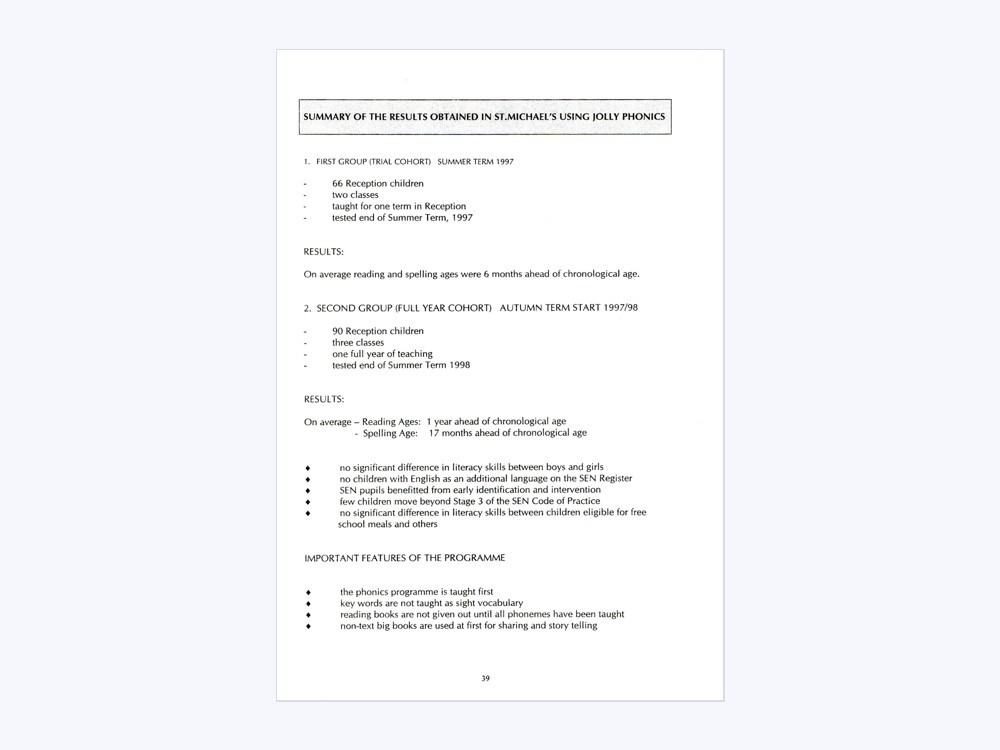
Marlynne Grant’s evaluation records reading and spelling outcomes for successive Reception cohorts using Jolly Phonics. The summary distinguishes a one-term trial from a full-year cohort. Read those periods separately: this is a school evaluation, and the reported reading-age gains should be understood in that setting.

Read source (PDF 3.3MB)
Document preview: Synthetic phonics in low-income schools

Comparative study · Publication date unconfirmed

Hyderabad, India

Synthetic phonics in low-income schools

Pauline Dixon, James Tooley and Andrew Hunt report on a six-month project involving more than 500 children in 22 schools. Schools using Jolly Phonics were compared with schools continuing their existing English teaching. The authors report a significant difference on five of six tests; the results relate to these schools and teaching conditions.

Read source (PDF 417KB)
Document preview: Older and younger pupils learning together

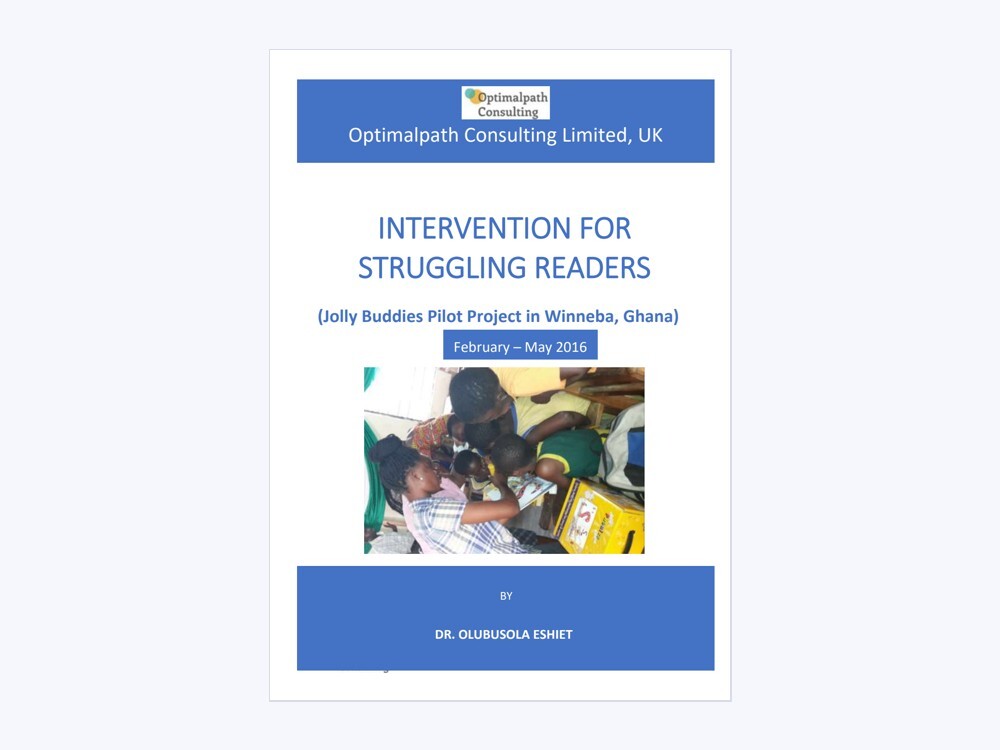
Jolly Buddies pilot · Study period 2016 · Publication date unconfirmed

Winneba, Ghana

Older and younger pupils learning together

Olubusola Eshiet’s Jolly Buddies pilot paired older pupils with younger struggling readers, using Jolly Phonics Extra materials. The report describes the February–May intervention, training, monitoring and reading assessments. It offers implementation context for peer-supported reading; the reported gains are specific to this pilot.

Read source (PDF 916KB)
Document preview: Monitoring early reading in primary schools

Implementation evaluation · Study period 2014 · Publication date unconfirmed

Abuja, Nigeria

Monitoring early reading in primary schools

The Federal Capital Territory report describes monitoring across 12 primary schools, assessing 160 pupils in Jolly Phonics classes and 80 pupils in comparison classes. It combines reading assessments with observations of implementation. The report provides local programme evidence, including the training and monitoring that accompanied teaching.

Read source (PDF 1.6MB)
Document preview: Research and implementation in Cross River

Report and dissertation collection · Publication date unconfirmed

Cross River, Nigeria

Research and implementation in Cross River

This collection includes a University of Calabar pilot report, Sarah Shepherd’s dissertation and a Jolly Phonics promotional case study. They examine synthetic phonics and early literacy in Cross River. The documents describe different periods and perspectives; they are grouped here without treating them as one identical cohort or adding their results together.

Read source (PDF 342KB)
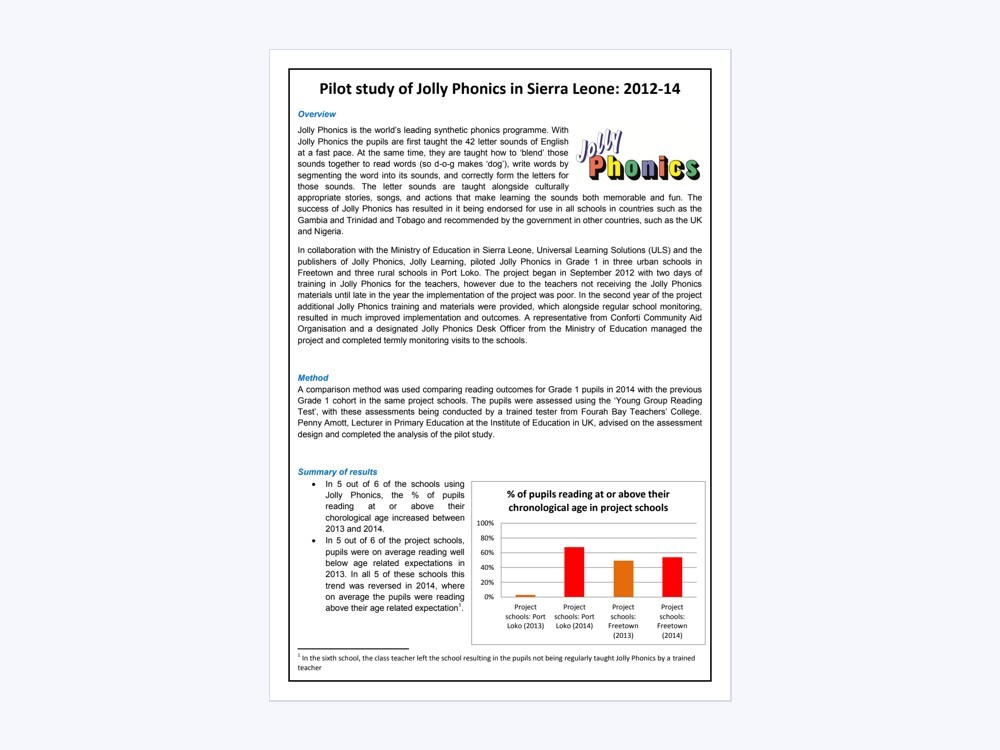
Document preview: A two-year primary-school pilot

Pilot overview · Study period 2012–14 · Publication date unconfirmed

Sierra Leone

A two-year primary-school pilot

The two-page overview covers three urban and three rural schools. It describes delayed materials in the first year and improved implementation following further training, materials and monitoring. Reading outcomes compare successive Grade 1 cohorts, so this is a historical-cohort comparison rather than a randomised trial.

Read source (PDF 408KB)

See Jolly Phonics in real classrooms.

Discover how schools and teachers put Jolly Phonics into practice.

Explore our case studies