


Jolly Phonics teaches blending for reading and segmenting for spelling through explicit modelling, guided practice and independent application. Children begin reading words as soon as they know the letter-sound correspondences in those words; they do not need to learn all 42 sounds first. Regular checks help teachers decide whether a pupil needs more practice with sound recall, blending or spelling.
How Jolly Phonics teaches blending for reading
Blending is the process of saying individual letter sounds in a word and running them together to form a spoken word (e.g., saying /s/ - /a/ - /t/ and blending it into “sat”).
Because blending is not always intuitive for young children, Jolly Phonics teaches it explicitly:
Sound-first foundation
Jolly Phonics teaches letter sounds so pupils can use them to read. Once a child knows all the correspondences in a suitable word, the teacher models how to say and join those sounds. For example, pupils who know s, a and t can practise reading sat.
Explicit teacher modelling
The teacher explicitly demonstrates the process aloud. For example, when reading pin, the teacher points to each grapheme, says /p/, /i/, /n/ without an added vowel and joins the sounds to say the whole word. Pupils practise with the teacher before trying independently.
Gradual pacing
Initially, sounds are said close together so the children can catch the word. As children grow more confident, they transition from teacher-led blending to doing it independently or with a partner using resources such as the flashcards, magnetic letters or Jolly Classroom activities.
Early success via letter groupings
The 42 sounds are taught in specific groups (starting with s, a, t, i, p, n) specifically because this small group allows children to start blending and reading dozens of words right away (e.g., pin, sit, pat, ant, tap).
Why can a child say the sounds but struggle to blend?
Knowing individual letter sounds and joining those sounds into a word are different skills. Check whether the pupil can recall each correspondence, hear a word when an adult says its sounds, and blend from print without losing the sequence. Use the response to choose the next teaching step.
| What you observe | What to check | What to practise next |
|---|---|---|
| A pupil pauses or gives the wrong sound. | Can they recall each grapheme in the word independently? | Revisit the uncertain correspondence, then return to a suitable word. |
| A pupil says each sound but does not hear the word. | Can they blend the sounds when an adult says them? | Model oral blending and provide guided practice alongside familiar print. |
| A pupil adds “uh” to consonants. | Is the extra vowel making the sequence harder to join? | Model the programme’s clear sound pronunciation and blend the word again. |
| A pupil loses their place or omits a sound. | Can they track the graphemes from left to right? | Point to each grapheme and model the sequence using an appropriate shorter word. |
| A pupil guesses from a picture or the first letter. | Have all the word’s correspondences been taught? | Return attention to the full written word and model decoding it. |
These are teaching checks, not a diagnosis of a learning difficulty. A child may need support with more than one step.
A worked example using taught sounds
If a pupil has learned s, a and t, show sat. Check the sounds, model reading from left to right and join them into the whole word. Practise together, then ask the pupil to try without your model.
If the pupil still cannot hear the word, say the sounds yourself and check oral blending. If sound recall is uncertain, revisit that correspondence. Record what the pupil did independently and the help needed, then check a fresh suitable word containing taught correspondences at the next planned review.
Keep catch-up practice consistent
Use the school’s normal sound pronunciations, resources and prompts during additional practice. Choose a small, manageable focus from assessment and provide regular opportunities to rehearse it. Keep checking whether the pupil can apply the skill independently, rather than only repeat the adult’s example.
If progress remains limited despite targeted support, share the record with the phonics lead or SENCO. Include the content checked, the pupil’s responses, support provided and progress over time.
How Jolly Phonics teaches segmenting for spelling
Segmenting is the reverse of blending. It is the ability to hear a whole spoken word and break it down into its individual component sounds (e.g., hearing the word “dog” and identifying /d/ - /o/ - /g/). This skill is essential for spelling and writing.
Jolly Phonics approaches segmenting through targeted daily practice:
Listening and identifying
Children are trained to listen closely to spoken words. Teachers often start with fun oral games (e.g., “I Spy” using sounds: “Can you find a p-e-n?”).
Sound counting (Elkonin boxes/finger counting)
Children are taught to map sounds to their fingers or use visual boxes. For instance, for the word “cat”, a child holds up three fingers (one for each sound: /c/, /a/, /t/) or places counters in three boxes representing the phonemes.
Connecting to writing
Once a child can orally segment a word into sounds, they are taught to match each sound to its corresponding letter shape. If they want to write the word “tap”, they segment it into /t/ - /a/ - /p/ and write the corresponding letters down sequentially.
Practising both skills in daily lessons
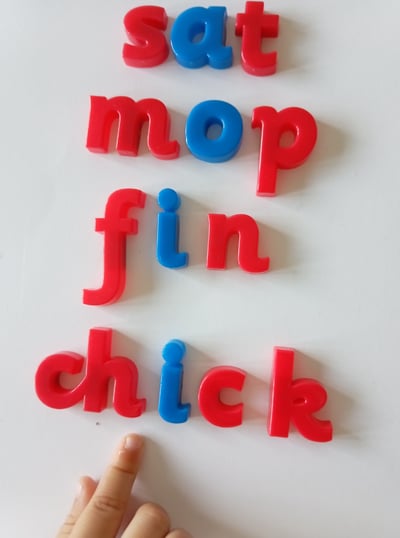
In a typical Jolly Phonics lesson plan, blending and segmenting are practised together, using the programme resources and following the daily lesson plans.
Blending practice
The programme provides new decodable words in each lesson and the class practises sounding them out and blending them together to read.
Dictation / segmenting practice
The teacher says a word aloud; the class segments it into sounds (often using their fingers to count the sounds) and then writes the spelling down. Dictation words and sentences provide segmenting practice, letter formation and handwriting skills.
Using these methods alongside matched decodable reading practice helps pupils apply their sound-to-letter knowledge in both reading and spelling.
In the Jolly Phonics programme, several resources are specifically designed to support the development of blending (reading) and segmenting (spelling) skills.
What resources are used in Jolly Phonics for blending and segmenting?
Jolly Phonics provides a wide range of resources to support the development of blending and segmenting skills, many of which can be adapted to meet the needs of young learners, children with SEND, and those with English as an additional language (EAL).
The programme encourages a multisensory approach to learning, enabling children to see, hear, say, and physically engage with sounds through activities such as actions, air writing, magnetic letters, and flashcards. These strategies help to reinforce letter-sound relationships and make phonics learning more accessible and memorable. In addition, children need regular opportunities to apply their blending and segmenting skills in meaningful contexts.
Jolly Phonics decodable readers provide carefully structured reading materials that allow children to practise these skills independently, helping to develop reading fluency, confidence, and comprehension.
Resources for blending (reading)
Little Word Books
These provide structured practice in blending sounds to read words and simple sentences. The books are linked to the Jolly Phonics sound groups and are designed to help children apply newly learned letter sounds in reading.
Read and See Books
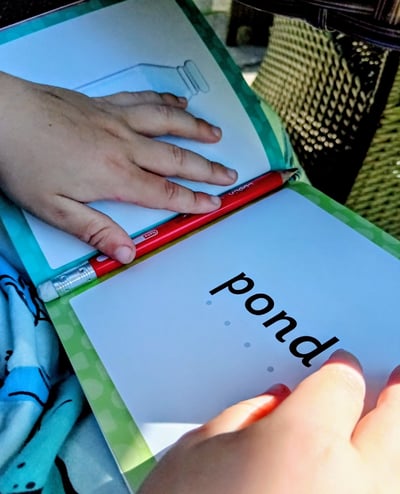
Children blend sounds to read a word and then check a picture on the following page to confirm they have decoded it correctly. The books include sound dots to support sounding out words.
Decodable readers
Choose Jolly Phonics decodable readers that match the letter sounds, tricky words and spellings the pupil has already been taught. They provide meaningful reading practice while reinforcing blending skills and building fluency.
Jolly Phonics Picture Flashcards and Flashcards
Letter-sound cards and picture flashcards are used to teach and review the sounds needed for blending activities.
The picture flashcards reinforce both the letter shape and its corresponding sound, providing a clear visual cue to support children's phonics development. When used, the ‘sound dots’ under each letter sound help children identify and segment the individual sounds within words.
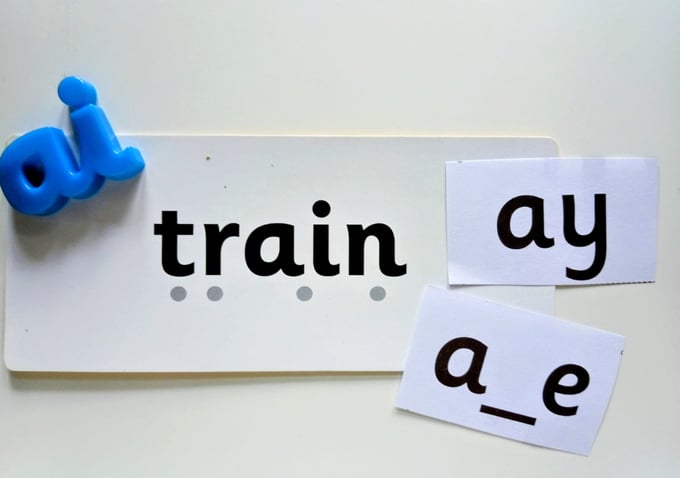
The flashcards also contain groups of words that align with the Jolly Phonics letter-sound groups, allowing children to revisit previously learned sounds while introducing new ones. This structured progression supports the development of both blending for reading and segmenting for spelling.
Resources for segmenting (spelling)
Jolly Phonics Pupil Books
The Pupil Books play an important role in developing children's segmenting skills by providing a range of structured activities that encourage them to listen carefully to the sounds within words and represent those sounds using the correct letters.
Children are guided to identify the individual phonemes in spoken words, break words down into their component sounds, and record each sound in sequence. As they progress, activities move from simple consonant-vowel-consonant (CVC) words to more complex words containing digraphs, consonant blends, and alternative spellings.
Jolly Phonics Word Bank
The Word Bank contains words, phrases, and sentences organised according to phonics patterns. It is recommended as a source of words for spelling, dictation, and segmenting practice.
Jolly Phonics Word Book
This resource provides further practice with phonically regular words and spelling patterns, supporting both reading and writing development.
Dictation and writing activities
Within the Teacher's Book and Pupil Books, children are regularly encouraged to listen carefully to spoken words, identify the individual sounds they can hear, and record the corresponding letters or letter groups.
Through guided activities, modelling by the teacher, and independent practice, children learn to break words down into their separate phonemes before attempting to spell them. This process helps them understand that words are made up of individual sounds that can be represented in writing.
The activities progressively increase in complexity, beginning with simple words before moving on to words containing digraphs, consonant blends, and alternative spellings. Teachers use dictation, word-building tasks, sound identification exercises, and guided writing opportunities to support children in applying their phonics knowledge.
Regular practice allows children to develop their phonemic awareness, strengthen their understanding of sound-to-letter correspondences, and become more accurate and confident spellers.
By repeatedly hearing, segmenting, and writing the sounds, children develop the essential encoding skills needed for spelling, writing, and overall literacy development.
Frequently asked questions about blending and segmenting
What is the difference between blending and segmenting?
Blending joins sounds to read a word. Segmenting separates a spoken word into its sounds so the pupil can represent them with graphemes for spelling. Teaching both helps pupils apply the same correspondences in reading and writing.
Should I show a picture to help a child read an unfamiliar word?
Use the printed word and taught correspondences to support decoding. Pictures can support vocabulary and discussion, but should not replace reading the word. In Read and See Books, the picture is a check after pupils have blended the printed word.
What should I record when a pupil cannot blend?
Record the word and correspondences checked, the pupil’s independent response, whether oral blending was possible, the support provided and the next review. This makes additional practice specific and helps colleagues use consistent prompts.
