


About the School
Every child learns differently. For specialist schools supporting pupils with a wide range of additional needs, finding an approach to phonics that is engaging, accessible and adaptable can be particularly challenging.
At Ellen Tinkham School, pupils aged 4–18 have diverse learning needs, including profound and multiple learning difficulties, autism and additional communication needs.
Classes bring together children working at different stages of phonics development, meaning teachers and support staff must find creative ways to make learning accessible to everyone.
Lucy Hardacre, who is the HLTA literacy lead, has developed a tailored phonics approach that brings together resources from different programmes, with Jolly Phonics songs and actions playing an important role.
Finding a Phonics Approach That Works for Different Needs
With pupils working across a wide range of abilities, the school needed a phonics approach that offered flexibility, repetition and opportunities for sensory learning.
Lucy found that existing phonics programmes, even those offering additional support for pupils with special educational needs, often progressed too quickly for some learners.
At the same time, classes could contain pupils working at very different phonics stages, making it difficult to follow a single lesson sequence.
For older students, another challenge was ensuring that early phonics teaching remained engaging and age-appropriate.
Rather than adopting one programme in its entirety, Lucy developed a bespoke approach that could be adapted to the needs of individual pupils.
Why Jolly Phonics? The Power of Songs and Actions
Jolly Phonics had already been used at the school for several years before Lucy joined.
Its songs and actions have remained an important part of the school's phonics teaching, particularly for pupils who benefit from repetition, movement and alternative ways to communicate.
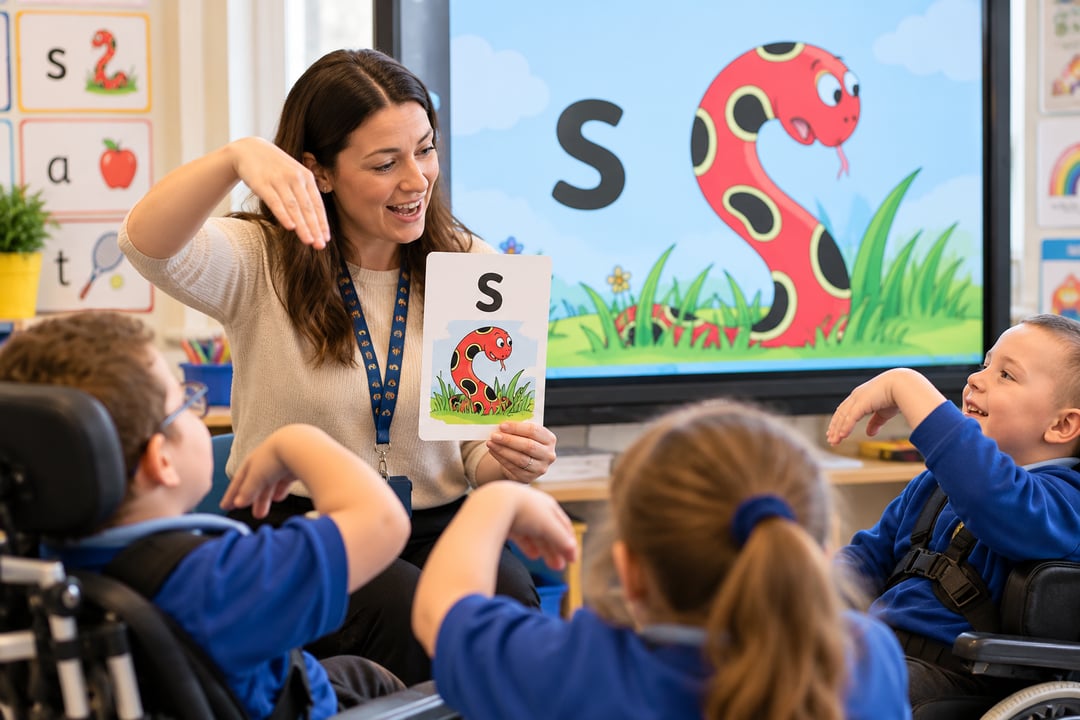
Each letter sound is introduced alongside its associated Jolly Phonics song and action, giving pupils different ways to engage with and remember their learning.
For some children, the actions provide more than a memory aid. They offer a way to demonstrate understanding without relying on spoken language.
Lucy has observed pupils who are unable to give a verbal response but can demonstrate recognition of a sound through the corresponding action.
She also recalled working with a pupil with Down syndrome who found responding to flashcards difficult but could recall and perform the actions.
These experiences have reinforced the school's commitment to using multisensory approaches in its phonics teaching.
Implementation: A Flexible, Sensory-Based Approach
To meet the needs of its learners, the school has developed its own phonics planning, incorporating Jolly Phonics alongside other teaching resources.
The current approach generally introduces two letter sounds each week, with a dedicated review day to revisit previous learning.
This slower pace gives pupils additional time to become familiar with each sound before moving on.
Lessons begin with an introductory presentation, followed by the relevant Jolly Phonics song and action. Pupils are also introduced to the corresponding Makaton sign before moving into practical activities.
Songs, movement and repetition are central to the approach, helping pupils participate in ways that suit their individual needs.
The school also uses Jolly Phonics flashcards and has previously created classroom displays using the programme's wall friezes.
Importantly, teaching is not limited to one format.
Some pupils respond particularly well to digital resources, while others prefer printed materials, physical activities or opportunities for mark-making.
This flexibility allows staff to adapt learning to the pupils in front of them.


